Anotações de Geometria Computacional
Notas de aula da disciplina de Geometria computacional.
Conceitos básicos e primitivas
Orientação relativa de vetores
Para determinar a orientação de dois vetores no \(\mathbb{R}^2\) , podemos calcular o determinante formado pelos vetores \(\vec{v_1} = (x_1, y_1)\) e \(\vec{v_2} = (x_2, y_2)\) , definido como:
\[\vec{v_1} \times \vec{v_2} = x_1 y_2 - x_2 y_1.\]Se \(\vec{v_1} \times \vec{v_2} < 0\) o vetor \(\vec{v_2}\) está à esquerda de \(\vec{v_1}\). De forma simétrica, se \(\vec{v_1} \times \vec{v_2} > 0\) , o vetor \(\vec{v_2}\) está à direita de \(\vec{v_1}\) .
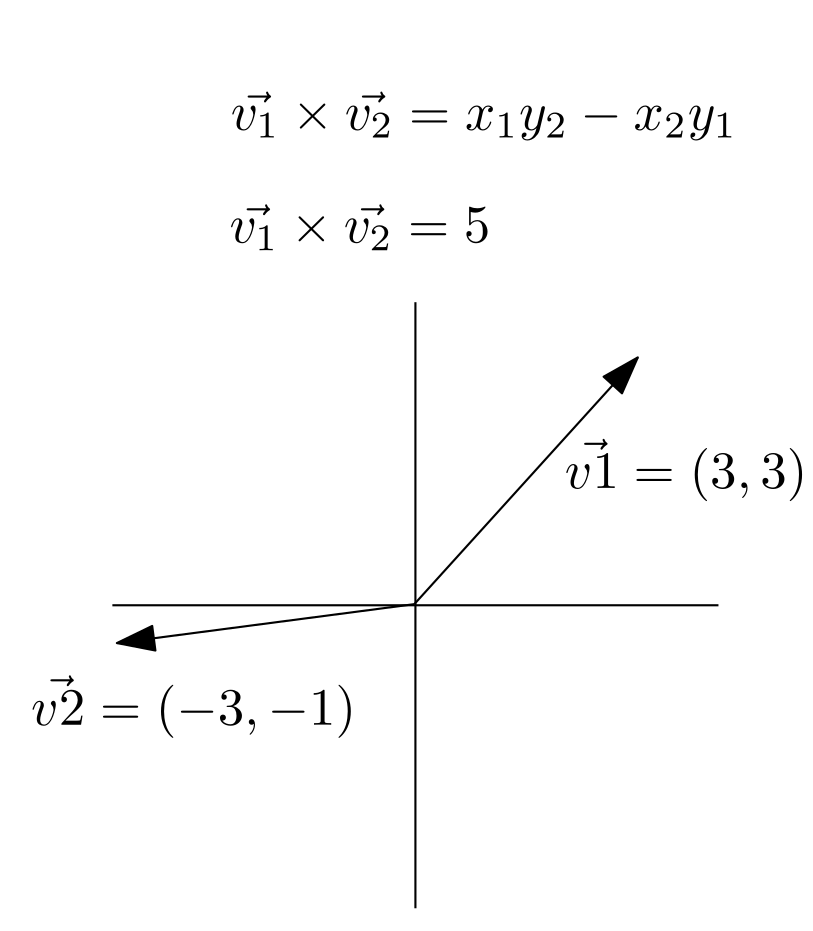 O vetor \(\vec{v_2}\) está à esquerda do vetor \(\vec{v_1}\) .
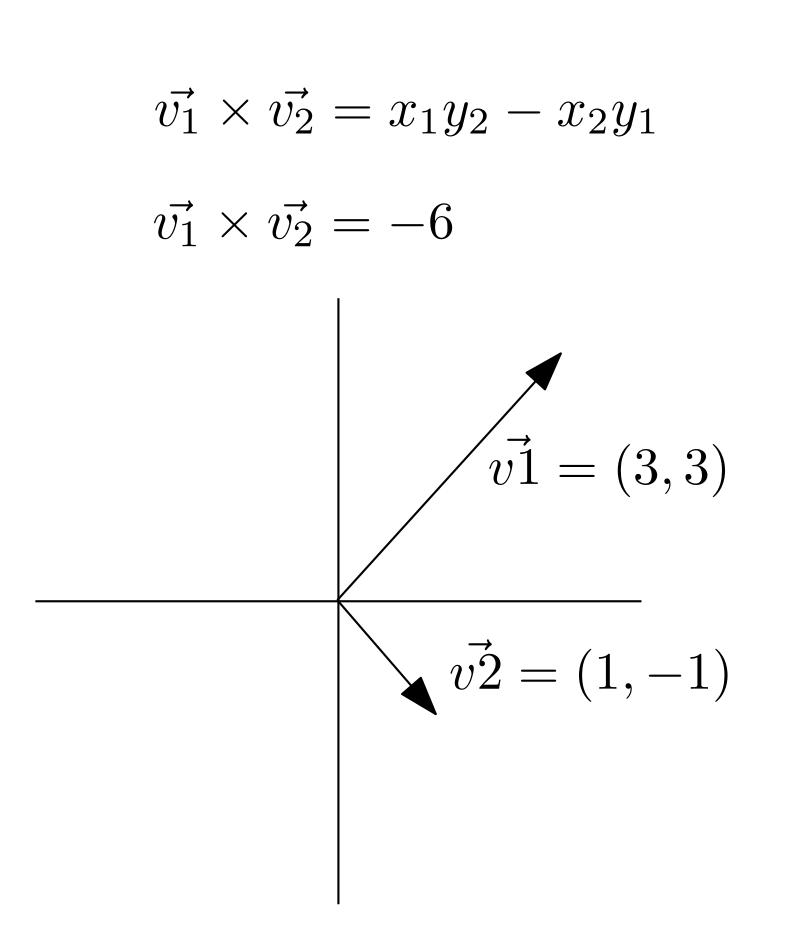 O vetor \(\vec{v_2}\) está à direita do vetor \(\vec{v_1}\) .
Área orientada de polígonos planos
O valor absoluto do determinante formado pelos vetores \(\vec{v_1}\) e \(\vec{v_2}\) está relacionado com a área do paralelogramo definido entre eles.
Fórmula Shoelace
Seja um polígono simples com vérices \((x_1, y_1), (x_2, y_2), \dots, (x_n, y_n)\) no plano \(\mathbb{R}^2\) a área \(S\) desse polígono é dada por:
\[S = \frac{1}{2} |(x_1y_2 + x_2y_3 + \dots + x_ny_1) - (y_1x_2 + y_2x_3 + \dots + y_nx_1)|\]Exemplo: Vértices na ordem: \((8,2),\; (-7,10),\; (-5,-2),\; (-9,-2),\; (0,-10).\) Montando o “determinante” do método:
\[\begin{aligned} \text{soma}_\rightarrow &= x_1y_2 + x_2y_3 + x_3y_4 + x_4y_5 + x_5y_1 \\ &= 8\cdot 10 \;+\; (-7)\cdot(-2) \;+\; (-5)\cdot(-2) \;+\; (-9)\cdot(-10) \;+\; 0\cdot 2 \\ &= 80 \;+\; 14 \;+\; 10 \;+\; 90 \;+\; 0 \\ &= 194, \\[6pt] \text{soma}_\leftarrow &= y_1x_2 + y_2x_3 + y_3x_4 + y_4x_5 + y_5x_1 \\ &= 2\cdot(-7) \;+\; 10\cdot(-5) \;+\; (-2)\cdot(-9) \;+\; (-2)\cdot 0 \;+\; (-10)\cdot 8 \\ &= -14 \;-\; 50 \;+\; 18 \;+\; 0 \;-\; 80 \\ &= -126. \end{aligned}\]Logo,
\[S \;=\; \frac{1}{2}\,\big|\,\text{soma}_\rightarrow - \text{soma}_\leftarrow\,\big| \;=\; \frac{1}{2}\,\big|\,194 - (-126)\,\big| \;=\; \frac{1}{2}\cdot 320 \;=\; \boxed{160}.\]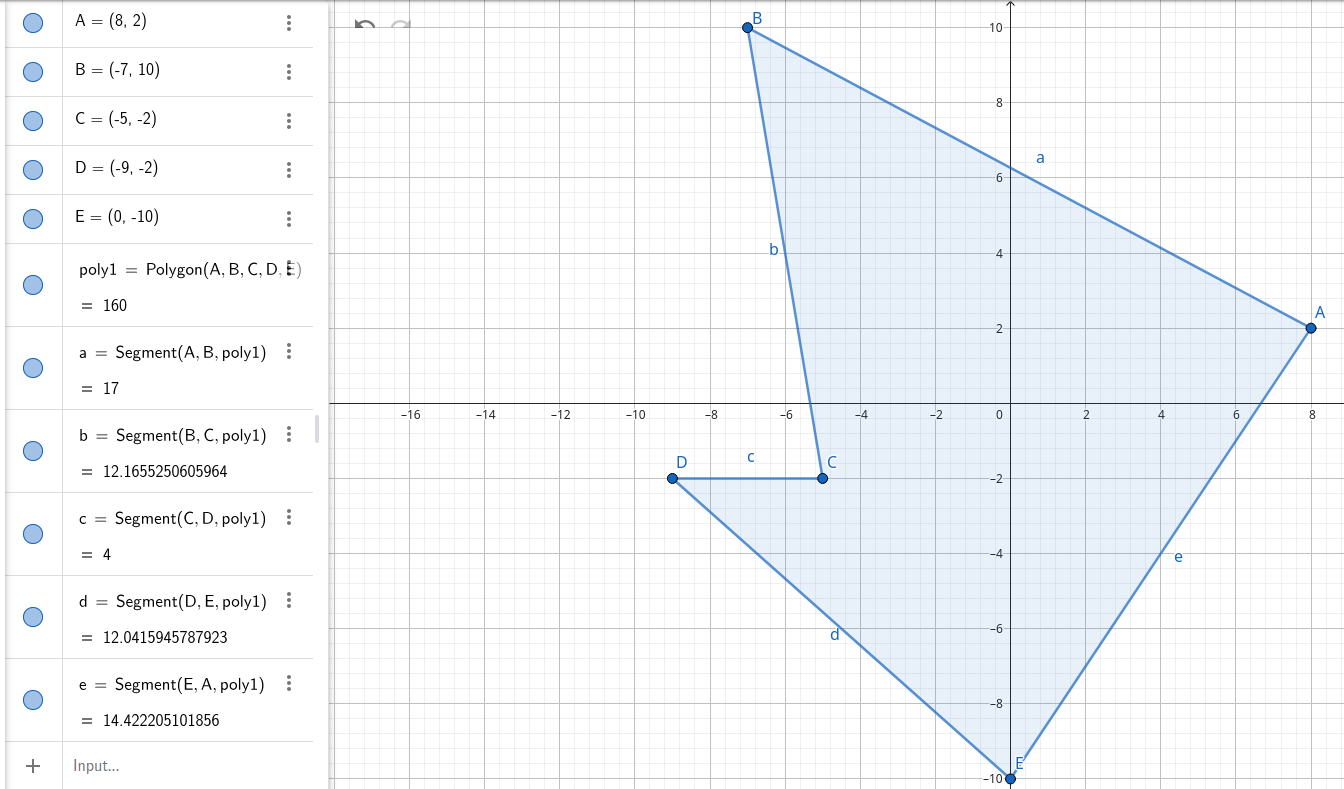 O Polígono do exemplo gerado no GeoGebra .
Implementação
Orientação Relativa
Aqui temos uma implentação direta do conceito de orientação relativa, primitiva que será amplamente utilizada posteriormente, testamos se o ponto \(r\) está à esquerda do segmento formado pelos pontos \(p\) e \(q\).
1
2
3
4
5
6
7
8
9
10
11
12
13
14
15
int left2(CGL::Point2 p, CGL::Point2 q, CGL::Point2 r)
    {
        return (q.x() - p.x()) * (r.y() - p.y()) - (q.y() - p.y()) * (r.x() - p.x()) > 0;
    }

    int right2(CGL::Point2 p, CGL::Point2 q, CGL::Point2 r)
    {
        return (q.x() - p.x()) * (r.y() - p.y()) - (q.y() - p.y()) * (r.x() - p.x()) < 0;
    }

    int collinear2(CGL::Point2 p, CGL::Point2 q, CGL::Point2 r)
    {
        return (q.x() - p.x()) * (r.y() - p.y()) - (q.y() - p.y()) * (r.x() - p.x()) == 0;
    }
Fórmula de Shoelace
Implementação da fórmula de shoelace para um polígono com n lados.
1
2
3
4
5
6
7
8
9
10
11
12
13
14
15
double areaPoligono(CGL::Polygon2 poligono, int nVertices)
    {
        double soma = 0.0;

        // formuula shoelace
        for(int i = 0 ; i < nVertices; i++)
        {
            CGL::Point2 p1 = poligono[i];
            CGL::Point2 p2 = poligono[(i + 1) % nVertices];
            soma += (p1.x() * p2.y()) - (p1.y() * p2.x());

        }

        return soma/2.0;
    }
Intersecção de Segmentos
Nesta seção detalharemos mais uma operação básica que será amplamente utilizada posteriormente, que é a intersecção de segmentos
Intersecção Própria
Problema: dado dois segmentos \(ab\) e \(cd\) no \(\mathbb{R}^2\) e usando o produto vetorial definido acima, determinar se eles se interceptam.
Solução: os segmentos se interceptam se os pontos \(C\) e \(D\) estão em lados opostos em relação ao segmento \(ab\) e, ao mesmo tempo, os pontos \(A\) e \(B\) estão de lados opostos em relação ao segmento \(cd\). Para tal é necessário que os vetores \(\overrightarrow{AC}\) e \(\overrightarrow{AD}\) tenham orientações diferentes com relação a \(\overrightarrow{AB}\), ou seja, \((\overrightarrow{AB} \times \overrightarrow{AC}) \cdot (\overrightarrow{AB} \times \overrightarrow{AD}) < 0\). O mesmo é necessário para \(\overrightarrow{CA}\) e \(\overrightarrow{CB}\) com a relação a \(\overrightarrow{CD}\).
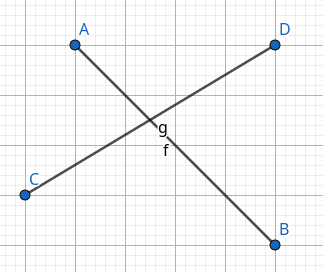 Intersecção dos segmentos do gerado no GeoGebra .
Implementação
Implementação da ideia descrita acima utilizando as primitivas já citadas de left e collinear .
1
2
3
4
5
6
7
8
int intersecPropria2(CGL::Segment2 s, CGL::Segment2 t)
    {
        if (collinear2(s[0], s[1], t[0]) || collinear2(s[0], s[1], t[1]) || collinear2(t[0], t[1], s[0]) || collinear2(t[0], t[1], s[1])) return 0;
        int a = left2(s[0], s[1], t[0]) xor left2(s[0], s[1], t[1]);
        int b = left2(t[0], t[1], s[0]) xor left2(t[0], t[1], s[1]);
        return a && b;
    }
Intersecção Imprópria
No nosso contexto, definimos intersecção imprópria em dois casos:
- Um extremo de um segmento coincide com um extremo do outro
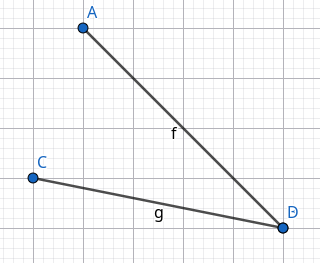 Intersecção dos segmentos do gerado no GeoGebra .
 - Os segmentos são colineares e sobrepostos
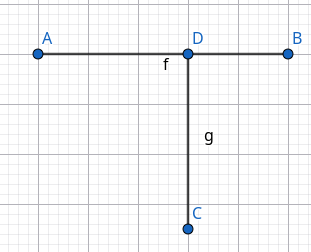 Intersecção dos segmentos do gerado no GeoGebra .
Implementação
1
2
3
4
5
6
7
8
9
10
11
12
13
14
15
16
17
18
int noMeio(int a, int b, int c)
    {
        return (std::min(a, b) <= c) && (c <= std::max(a, b));
    }

    int noSegmento(CGL::Point2 a, CGL::Point2 b, CGL::Point2 c)
    {
        return collinear2(a, b, c) && noMeio(a.x(), b.x(), c.x()) && noMeio(a.y(), b.y(), c.y());
    }

    int intersecImpropria2(CGL::Segment2 s, CGL::Segment2 t)
    {
        if (s[0] == t[0] || s[0] == t[1] || s[1] == t[0] || s[1] == t[1]) return 1;
        if (noSegmento(s[0], s[1], t[0]) || noSegmento(s[0], s[1], t[1]) || noSegmento(t[0], t[1], s[0]) || noSegmento(t[0], t[1], s[1])) return 1;
        return 0;
    }
Triangulação de polígonos
Particionamento de Polígonos em Pedaços Monótonos
Introdução
O particionamento de polígonos é um problema fundamental em geometria computacional. Dado um polígono simples (sem auto-interseções), o objetivo é dividi-lo em pedaços mais simples que sejam mais fáceis de processar. Uma das decomposições mais úteis é o particionamento em polígonos monótonos, especialmente polígonos y-monótonos.
Um polígono é y-monótono quando qualquer linha horizontal o intersecta em no máximo dois pontos. Isso significa que, ao percorrer o polígono de cima para baixo, nunca precisamos “voltar” na direção vertical.
Por que Particionar?
Polígonos monótonos são muito mais fáceis de triangular do que polígonos arbitrários. Uma vez que temos um polígono y-monótono, podemos triangulá-lo em tempo linear usando um algoritmo simples de varredura. Portanto, a estratégia geral para triangular um polígono qualquer é:
- Particionar o polígono em pedaços y-monótonos
- Triangular cada pedaço separadamente
Classificação de Vértices
O algoritmo começa classificando cada vértice do polígono em um de cinco tipos, baseado em sua posição relativa aos vértices adjacentes e no ângulo interno:
1. Start Vertex
- Ambos os vizinhos estão abaixo do vértice
- O ângulo interno é menor que 180° (convexo)
- Intuitivamente: o polígono “começa” neste ponto ao descer
2. Split Vertex
- Ambos os vizinhos estão abaixo do vértice
- O ângulo interno é maior que 180° (côncavo)
- Este vértice “divide” o polígono e precisa de uma diagonal
3. End Vertex
- Ambos os vizinhos estão acima do vértice
- O ângulo interno é menor que 180° (convexo)
- Intuitivamente: o polígono “termina” neste ponto ao descer
4. Merge Vertex
- Ambos os vizinhos estão acima do vértice
- O ângulo interno é maior que 180° (côncavo)
- Dois “ramos” do polígono se juntam aqui
5. Regular Vertex
- Um vizinho está acima e outro abaixo
- O polígono continua normalmente através deste vértice
O Algoritmo de Varredura (Sweep Line)
O algoritmo usa a técnica de linha de varredura (sweep line), processando os vértices de cima para baixo (ordenados pela coordenada y decrescente).
Estruturas de Dados
- Status da linha de varredura: Mantém as arestas que atualmente intersectam a linha de varredura horizontal
- Helper: Para cada aresta no status, armazena o último vértice que “ajudou” essa aresta (conceito explicado abaixo)
- Diagonais: Lista de diagonais que precisam ser inseridas
Conceito de Helper
O helper de uma aresta $e_j$ é o vértice mais baixo que está acima da linha de varredura atual, tal que o segmento horizontal conectando esse vértice a aresta $e_j$ esteja completamente dentro do polígono.
Tratamento de Cada Tipo de Vértice
Start Vertex
1
2
1. Insere a aresta que sai do vértice no status
2. Define este vértice como helper dessa aresta
End Vertex
1
2
3
1. Verifica se o helper da aresta que entra é MERGE
2. Se sim, adiciona diagonal entre o vértice atual e o helper
3. Remove a aresta do status
Split Vertex
1
2
3
4
1. Encontra a aresta diretamente à esquerda do vértice
2. Adiciona diagonal entre o vértice atual e o helper dessa aresta
3. Atualiza o helper da aresta à esquerda
4. Insere a aresta que sai no status
Merge Vertex
1
2
3
4
5
1. Se o helper da aresta que entra é MERGE, adiciona diagonal
2. Remove a aresta que entra do status
3. Encontra a aresta à esquerda
4. Se o helper dessa aresta é MERGE, adiciona diagonal
5. Atualiza o helper da aresta à esquerda
Regular Vertex
O tratamento depende se o interior do polígono está à direita ou à esquerda:
Se interior está à esquerda:
1
2
3
4
1. Se helper da aresta que entra é MERGE, adiciona diagonal
2. Remove aresta que entra do status
3. Insere aresta que sai no status
4. Define vértice atual como helper da nova aresta
Se interior está à direita:
1
2
3
1. Encontra aresta à esquerda
2. Se seu helper é MERGE, adiciona diagonal
3. Atualiza helper da aresta à esquerda
Encontrando a Aresta à Esquerda
Uma operação crucial é encontrar a aresta imediatamente à esquerda de um vértice. Isso é feito:
- Para cada aresta no status, calcula onde ela intersecta a linha horizontal que passa pelo vértice
- Dentre as interseções à esquerda do vértice, escolhe a mais próxima (com maior coordenada x)
Implementação
1
2
3
4
5
6
7
8
9
10
11
12
13
14
15
16
17
18
19
20
21
22
23
24
25
26
27
28
29
30
31
32
33
34
35
36
37
38
39
40
41
42
43
44
45
46
47
48
49
50
51
52
53
54
55
56
57
58
59
60
61
62
63
64
65
66
67
68
69
70
71
72
73
74
75
76
77
78
79
80
81
82
83
84
85
86
87
88
89
90
91
92
93
94
95
96
97
98
99
100
101
102
103
104
105
106
107
108
109
110
111
112
113
114
115
116
117
118
119
120
121
122
123
124
125
126
127
128
129
130
131
132
133
134
135
136
137
138
139
140
141
142
143
144
145
146
147
148
149
150
151
152
153
154
155
156
157
158
159
160
161
162
163
164
165
166
167
168
169
170
171
172
173
174
175
176
177
178
179
180
181
182
183
184
185
186
187
188
189
190
191
192
193
194
195
196
197
198
199
200
201
202
203
204
205
206
207
208
209
210
211
212
213
214
215
216
217
218
219
220
221
222
223
224
225
226
227
228
229
230
231
232
233
234
235
236
237
238
239
240
241
242
243
244
245
246
247
248
249
250
251
252
253
254
255
256
257
258
259
260
261
262
263
264
265
266
267
268
269
270
271
272
273
274
275
276
277
278
279
280
281
282
283
284
285
286
287
288
289
290
291
292
293
294
295
296
297
298
299
300
301
302
303
304
305
306
307
308
309
310
311
312
313
314
315
316
317
318
319
320
321
322
323
324
325
326
327
328
329
330
331
332
333
334
335
336
337
338
339
340
341
342
343
344
345
346
347
348
349
350
351
352
353
354
355
356
357
358
359
360
361
362
363
364
365
366
367
368
369
370
371
372
373
374
375
376
377
378
379
380
381
382
383
384
385
386
387
388
389
390
391
392
393
394
395
396
397
398
399
400
401
402
403
404
405
406
407
408
409
410
411
412
413
414
415
416
417
418
419
420
421
422
423
424
425
426
427
428
429
430
431
432
433
434
435
436
437
438
439
440
441
442
443
444
445
446
447
448
449
450
451
452
453
454
455
456
457
458
459
460
461
462
463
464
465
466
467
468
469
470
471
#include <iostream>
#include <CGAL/Arrangement_2.h>
#include <CGAL/Exact_predicates_exact_constructions_kernel.h>
#include <CGAL/Arr_segment_traits_2.h>
#include <vector>
#include <fstream>
#include <cmath>
#include <CGAL/draw_arrangement_2.h>
#include <string>

using std::string;
typedef CGAL::Exact_predicates_exact_constructions_kernel K;
typedef CGAL::Arr_segment_traits_2<K> Traits;
typedef CGAL::Arrangement_2<Traits> Arrangement;
typedef Traits::Point_2 Point_2;
typedef Traits::X_monotone_curve_2 Segment_2;


/// SVG Utils
double to_double(const K::FT& x) {
    return CGAL::to_double(x);
}

struct BBox {
    double xmin =  std::numeric_limits<double>::max();
    double ymin =  std::numeric_limits<double>::max();
    double xmax = -std::numeric_limits<double>::max();
    double ymax = -std::numeric_limits<double>::max();
};

BBox compute_bbox(const Arrangement& arr) {
    BBox b;
    for (auto vit = arr.vertices_begin(); vit != arr.vertices_end(); ++vit) {
        if (vit->is_at_open_boundary()) continue;
        auto p = vit->point();
        double x = to_double(p.x());
        double y = to_double(p.y());
        b.xmin = std::min(b.xmin, x);
        b.ymin = std::min(b.ymin, y);
        b.xmax = std::max(b.xmax, x);
        b.ymax = std::max(b.ymax, y);
    }
    return b;
}

double map_x(double x, const BBox& b, int W) {
    return 40 + (x - b.xmin) / (b.xmax - b.xmin) * (W - 80);
}

double map_y(double y, const BBox& b, int H) {
    return H - (40 + (y - b.ymin) / (b.ymax - b.ymin) * (H - 80));
}

void svg_arrow(std::ofstream& out,
               double x1, double y1,
               double x2, double y2,
               const string& color)
{
    out << "<line x1=\"" << x1 << "\" y1=\"" << y1
        << "\" x2=\"" << x2 << "\" y2=\"" << y2
        << "\" stroke=\"" << color
        << "\" stroke-width=\"2\" marker-end=\"url(#arrow)\" />\n";
}

void export_arrangement_svg(const Arrangement& arr,
                            const string& filename)
{
    const int W = 800;
    const int H = 800;

    std::ofstream svg(filename);
    BBox box = compute_bbox(arr);

    svg << "<svg xmlns=\"http://www.w3.org/2000/svg\" "
        << "width=\"" << W << "\" height=\"" << H << "\">\n";

    svg << R"(
<defs>
<marker id="arrow" markerWidth="10" markerHeight="10"
        refX="10" refY="3"
        orient="auto"
        markerUnits="strokeWidth">
  <path d="M0,0 L0,6 L9,3 z" fill="black"/>
</marker>
</defs>
)";

    for (auto he = arr.halfedges_begin();
         he != arr.halfedges_end(); ++he)
    {
        if (he->is_fictitious()) continue;

        auto p = he->source()->point();
        auto q = he->target()->point();

        double x1 = map_x(to_double(p.x()), box, W);
        double y1 = map_y(to_double(p.y()), box, H);
        double x2 = map_x(to_double(q.x()), box, W);
        double y2 = map_y(to_double(q.y()), box, H);

        bool interior_left = !he->face()->is_unbounded();

        string color = interior_left ? "red" : "gray";

        svg_arrow(svg, x1, y1, x2, y2, color);
    }

    for (auto vit = arr.vertices_begin();
         vit != arr.vertices_end(); ++vit)
    {
        if (vit->is_at_open_boundary()) continue;

        auto p = vit->point();
        double cx = map_x(to_double(p.x()), box, W);
        double cy = map_y(to_double(p.y()), box, H);

        svg << "<circle cx=\"" << cx
            << "\" cy=\"" << cy
            << "\" r=\"4\" fill=\"blue\" />\n";
    }

    svg << "</svg>\n";
    svg.close();
}

/// SVG Utils


enum VertexType { START, SPLIT, END, MERGE, REGULAR };

bool is_above(const Point_2& p1, const Point_2& p2)
{
    if (p1.y() == p2.y())
        return p1.x() < p2.x();
    return p1.y() > p2.y();
}

VertexType classify_vertex(Arrangement::Vertex_handle v)
{
    // Circulator que aponta para todas as arestas que apontam para um vértice
    Arrangement::Halfedge_around_vertex_circulator circ = v->incident_halfedges();
    Arrangement::Halfedge_around_vertex_circulator curr = circ;


    // Itera sobre os circulators para achar a aresta associada a face
    Arrangement::Halfedge_handle he_in;
    bool found = false;
    do {
        if (!curr->face()->is_unbounded())
        {
            he_in = curr;
            found = true;
            break;
        }
        ++curr;
    } while (curr != circ);

    if (!found) return REGULAR;

    Point_2 prev_pt = he_in->source()->point(); // ponto anterior no CCW
    Point_2 next_pt = he_in->next()->target()->point();// proximo ponto
    Point_2 curr_pt = v->point(); // ponto atual

    bool prev_is_below = is_above(curr_pt, prev_pt);
    bool next_is_below = is_above(curr_pt, next_pt);

    auto orientation = CGAL::orientation(prev_pt, curr_pt, next_pt);
    bool is_reflex = (orientation == CGAL::RIGHT_TURN);


    // classificação dos vértices do livro De Berg
    if (prev_is_below && next_is_below)
    {
        if (is_reflex) return SPLIT;
        return START;
    }
    if(!prev_is_below && !next_is_below)
    {
        if(is_reflex) return MERGE;
        return END;
    }

    return REGULAR;
}

Arrangement::Halfedge_handle get_incident_edge(Arrangement::Vertex_handle v)
{
    auto circ = v->incident_halfedges();
    auto curr = circ;
    do {
        if (!curr->face()->is_unbounded()) return curr;
        ++curr;
    } while (curr != circ);
    return Arrangement::Halfedge_handle();
}

struct Diagonal {
    Point_2 p1, p2;
};

std::map<Arrangement::Halfedge_handle, Arrangement::Vertex_handle> helper;
std::vector<Arrangement::Halfedge_handle> status;
std::vector<Diagonal> diagonals_to_insert;

void handle_start_vertex(Arrangement::Vertex_handle v)
{
    Arrangement::Halfedge_handle hin = get_incident_edge(v);
    if (hin == Arrangement::Halfedge_handle()) return; // Proteção

    Arrangement::Halfedge_handle hout = hin->next(); // aresta que sai

    status.push_back(hout); // coloca no status
    helper[hout] = v; // seta o helper
}

void handle_end_vertex(Arrangement::Vertex_handle v, Arrangement& arr)
{
    Arrangement::Halfedge_handle hin = get_incident_edge(v);
    if (hin == Arrangement::Halfedge_handle()) return;


    if (helper.count(hin) == 0) return;

    // Verifica se o helper da aresta é merge
    Arrangement::Vertex_handle v_helper = helper[hin];

    if(classify_vertex(v_helper) == MERGE) {
        diagonals_to_insert.push_back({v->point(), v_helper->point()});
    }

    // Remove a aresta do status
    auto it = std::find(status.begin(), status.end(), hin);
    if (it != status.end())
    {
        status.erase(it);
    }
}

Arrangement::Halfedge_handle find_left_edge(Arrangement::Vertex_handle v,
                                            const std::vector<Arrangement::Halfedge_handle>& status) {

    double vy = to_double(v->point().y());
    double vx = to_double(v->point().x());

    Arrangement::Halfedge_handle best_he;
    double max_x = -std::numeric_limits<double>::infinity();

    for (auto he : status) {
        auto p1 = he->source()->point();
        auto p2 = he->target()->point();

        double x1 = to_double(p1.x());
        double y1 = to_double(p1.y());
        double x2 = to_double(p2.x());
        double y2 = to_double(p2.y());

        double intersect_x;

        if (std::abs(y2 - y1) < 1e-9) {
            intersect_x = x1;
        } else {
            intersect_x = x1 + (vy - y1) * ((x2 - x1) / (y2 - y1));
        }

        if (intersect_x < vx && intersect_x > max_x) {
            max_x = intersect_x;
            best_he = he;
        }
    }

    return best_he;
}

void handle_split_vertex(Arrangement::Vertex_handle v, Arrangement& arr) {
    Arrangement::Halfedge_handle h_left = find_left_edge(v, status);

    if (h_left == Arrangement::Halfedge_handle()) return;

    if (helper.count(h_left) == 0) return;

    Arrangement::Vertex_handle helper_v = helper[h_left];

    diagonals_to_insert.push_back({v->point(), helper_v->point()}); // coloca diagonala entre v e o helper de ej

    helper[h_left] = v; // seta o helper

    Arrangement::Halfedge_handle hout = get_incident_edge(v);
    if (hout != Arrangement::Halfedge_handle())
    {
        hout = hout->next();
        status.push_back(hout); // coloca em status
        helper[hout] = v; // seta o helper
    }
}

void handle_merge_vertex(Arrangement::Vertex_handle v, Arrangement& arr)
{
    Arrangement::Halfedge_handle hin = get_incident_edge(v);
    if (hin == Arrangement::Halfedge_handle()) return;

    // PROTEÇÃO
    if (helper.count(hin) > 0)
    {
        Arrangement::Vertex_handle v_helper = helper[hin];
        if(classify_vertex(v_helper) == MERGE) // diagonal se o helper for merge
        {
            diagonals_to_insert.push_back({v->point(), v_helper->point()});
        }
    }

    // renove do status
    auto it = std::find(status.begin(), status.end(), hin);
    if (it != status.end())
    {
        status.erase(it);
    }

    Arrangement::Halfedge_handle h_left = find_left_edge(v, status);

    if (h_left != Arrangement::Halfedge_handle() && helper.count(h_left) > 0)
    {
        Arrangement::Vertex_handle helper_v = helper[h_left];

        if (classify_vertex(helper_v) == MERGE) {
            diagonals_to_insert.push_back({v->point(), helper_v->point()});
        }

        helper[h_left] = v;
    }
}

void handle_regular_vertex(Arrangement::Vertex_handle v, Arrangement& arr)
{
    Arrangement::Halfedge_handle he_in = get_incident_edge(v);
    if (he_in == Arrangement::Halfedge_handle()) return;

    Arrangement::Halfedge_handle he_out = he_in->next();

    bool interior_is_right = !is_above(v->point(), he_out->target()->point());

    if (interior_is_right) {
        Arrangement::Halfedge_handle h_left = find_left_edge(v, status);

        if (h_left != Arrangement::Halfedge_handle() && helper.count(h_left) > 0)
        {
            Arrangement::Vertex_handle helper_v = helper[h_left];

            if (classify_vertex(helper_v) == MERGE) {
                diagonals_to_insert.push_back({v->point(), helper_v->point()});
            }
            helper[h_left] = v;
        }
    }
    else
    {
        if (helper.count(he_in) > 0) {
            if (classify_vertex(helper[he_in]) == MERGE) {
                diagonals_to_insert.push_back({v->point(), helper[he_in]->point()});
            }
        }

        auto it = std::find(status.begin(), status.end(), he_in);
        if (it != status.end()) {
            status.erase(it);
        }

        status.push_back(he_out);
        helper[he_out] = v;
    }
}

int main()
{
    Arrangement arr;

    std::vector<Point_2> points;
    points.push_back(Point_2(0, 10));
    points.push_back(Point_2(8, 10));
    points.push_back(Point_2(8, 8));
    points.push_back(Point_2(2, 8));
    points.push_back(Point_2(2, 6));
    points.push_back(Point_2(6, 6));
    points.push_back(Point_2(6, 4));
    points.push_back(Point_2(2, 4));
    points.push_back(Point_2(2, 2));
    points.push_back(Point_2(8, 2));
    points.push_back(Point_2(8, 0));
    points.push_back(Point_2(0, 0));

    for (size_t i = 0; i < points.size(); ++i)
    {
        Point_2 p1 = points[i];
        Point_2 p2 = points[(i + 1) % points.size()];
        Segment_2 seg(p1, p2);
        CGAL::insert(arr, seg);
    }


    export_arrangement_svg(arr, "polygon_partitionedantes.svg");


    std::cout << "O arranjo tem " << arr.number_of_vertices() << " vertices e "
              << arr.number_of_edges() << " arestas." << std::endl;

    std::vector<Arrangement::Vertex_handle> vertices;

    for(auto it = arr.vertices_begin(); it != arr.vertices_end(); it++)
    {
        vertices.push_back(it);
    }

    std::sort(vertices.begin(), vertices.end(),
        [] (Arrangement::Vertex_handle v1, Arrangement::Vertex_handle v2)
    {
        if(v1->point().y() == v2->point().y())
            return v1->point().x() < v2->point().x();
        return v1->point().y() > v2->point().y();
    });

    std::cout << "Iniciando Sweep-Line..." << std::endl;

    helper.clear();
    status.clear();
    diagonals_to_insert.clear();

    for (auto v : vertices) {
        VertexType type = classify_vertex(v);

        switch (type) {
            case START:
                handle_start_vertex(v);
                break;
            case END:
                handle_end_vertex(v, arr);
                break;
            case SPLIT:
                handle_split_vertex(v, arr);
                break;
            case MERGE:
                handle_merge_vertex(v, arr);
                break;
            case REGULAR:
                handle_regular_vertex(v, arr);
                break;
        }
    }

    std::cout << "Sweep concluido. Inserindo " << diagonals_to_insert.size()
              << " diagonais..." << std::endl;

    for (const auto& diag : diagonals_to_insert) {
        Segment_2 seg(diag.p1, diag.p2);
        CGAL::insert(arr, seg);
    }

    std::cout << "Particao concluida." << std::endl;
    std::cout << "O arranjo final tem " << arr.number_of_edges()
              << " arestas (novas diagonais incluidas)." << std::endl;

    export_arrangement_svg(arr, "polygon_partitioned.svg");
    std::cout << "SVG gerado: polygon_partitioned.svg\n";

    return 0;
}
Resultados
O código também gera uma visualização SVG:
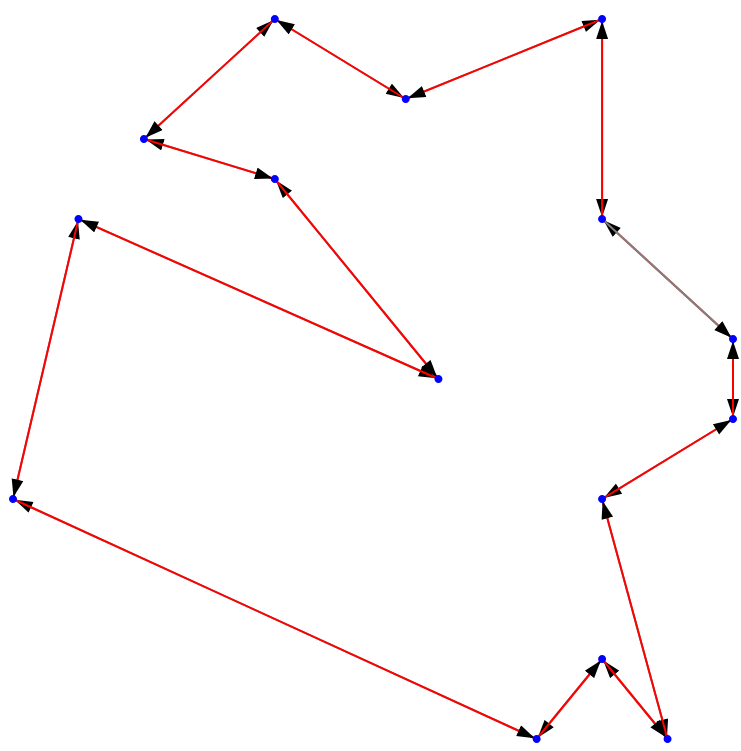 Polígono antes .
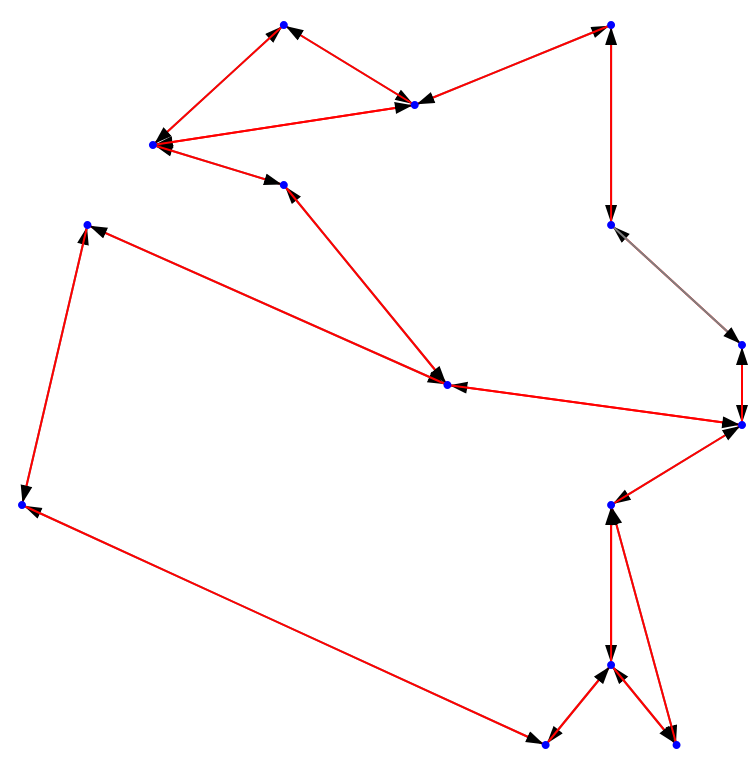 Polígono depois .
Convex Hull - Grahan Scan